


In the world of oil and gas equipment manufacturing, where long product lifecycles, conservative procurement cycles, and intense competition often spell slow change; genuine corporate turnarounds are rare. Yet one such story is unfolding quietly in Asia. A once-struggling business unit, written off by its Japanese parent, has reinvented itself into a growth-driven, globally connected manufacturer, and is now actively traded on Nasdaq, with undemanding valuation.
Beyond the numbers, OMS’s story is a case study in modern industrial entrepreneurship, one that mirrors the journeys of technology leaders such as Broadcom’s Tan E Hock and even Intel’s Pat Gelsinger. From a small-town engineer in Batu Pahat to the helm of a company supplying the world’s largest oil producers, Meng Hock embodies a new wave of leadership in Asia’s industrial sector: grounded, determined, and globally ambitious.
Post listing, the company also enters the next phase of its journey with a strong balance sheet, holding US$75.8 million in cash and trading at roughly 3x earnings with net profit of US$47.0 million in FYE2025, a valuation that underscores its turnaround potential and provides a significant margin of safety for investors.
This is the story of OMS Energy Technologies Inc. (NASDAQ: OMSE), a company that in 2020 was loss-making and directionless, however was listed in May 2025 with a valuation many times what its management paid to buy it out; all thanks to a bold entrepreneurial bet and a business rebuilt from the ground up.
Just five years ago, OMS’s future was deeply uncertain. As a subsidiary under Japan’s Sumitomo, the company had struggled for years with structural inefficiencies, weakening margins, and shrinking order books. Revenue in 2020 stood at only US$56 million, and profitability was elusive. Closure loomed and with it, the livelihoods of over 600 employees.
For one insider, however, walking away was not an option. Meng Hock How, who had risen through the ranks inside OMS, believed the company still had a future, but only if it were freed from corporate bureaucracy and rebuilt with entrepreneurial urgency.
In June 2023, he and a small team of partners took a risk few would attempt: they acquired 100% of OMS from Sumitomo for US$2 million, a price that reflected the company’s uncertain outlook but also its latent potential. The deal wasn’t motivated by profit alone; its first objective was survival. “This was about saving jobs and saving an ecosystem,” Meng Hock later said. “We believed the company could be more, but we had to move fast.”
Freed from its former corporate constraints, OMS embarked on a rapid restructuring, streamlining operations, investing in new manufacturing capabilities, and sharpening its focus on the technologies that matter most to exploration and production (E&P) clients.
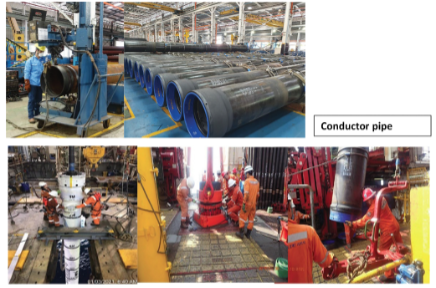
Today, OMS specialises in surface wellhead systems (SWS) and oil country tubular goods (OCTG), two of the most critical components in upstream oil and gas development. These are not commodity products; they are engineered to perform under extreme conditions, meeting stringent standards for temperature, pressure, corrosion, torque resistance, and abrasion. Certified by both the American Petroleum Institute (API) and the International Organization for Standardization (ISO), OMS’s solutions are designed to serve E&P operators where reliability cannot be compromised.
Its offerings include large-diameter weld-on specialty connectors used in offshore rigs, jack-up platforms, and ultra-deepwater operations, as well as fully qualified surface wellhead and “Christmas tree” systems built to API 6A standards. These systems control the flow of oil and gas from wellheads, ensure safe pressure management, and enable long-term field operations, all critical for upstream production efficiency and safety.
OMS’s strategy extends far beyond product engineering. In a sector where logistics, local compliance, and rapid technical support often decide contracts, the company’s geographical presence has become a key differentiator.
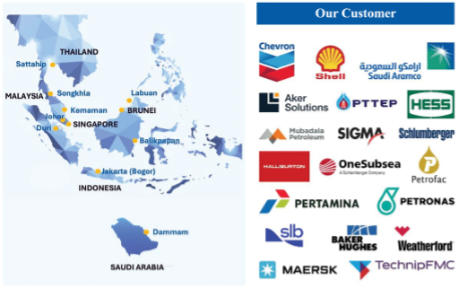
With facilities across Saudi Arabia, Indonesia, Thailand, Malaysia, Brunei, and Singapore, OMS operates close to its customers’ core assets. This localisation approach enables the company to tailor solutions, accelerate delivery, and maintain close technical collaboration with clients such as Saudi Aramco, Shell, Chevron, Petronas, Schlumberger, Halliburton, and TechnipFMC.
The result is a powerful commercial advantage: OMS is not merely a supplier, but a strategic partner embedded within the operational ecosystems of some of the world’s most demanding oil and gas producers. Beyond Asia and the Middle East, its products are also exported to North and West Africa, extending its reach into key hydrocarbon markets.
In May 2025, less than 23 months after the management buyout, OMS successfully listed on Nasdaq with a price of US$9 per share. The listing is not simply a financial milestone; it is a strategic pivot designed to strengthen the company’s balance sheet, secure corporate guarantees for larger projects, and accelerate its expansion across the Middle East and Africa.
The timing is significant. Global upstream investment is on the rise as energy security concerns drive new drilling activity in both mature and frontier markets. OMS’s proven track record, proximity to customers, and expanding portfolio position it well to capture this growth.

