


Why NeuroStream™ could become a critical layer of AI infrastructure
The artificial intelligence boom has been built on a simple formula: more chips, more servers and more power. Over the past several years, investors have poured capital into semiconductor makers, cloud providers and data center operators on the assumption that AI performance would keep improving as long as infrastructure kept expanding.
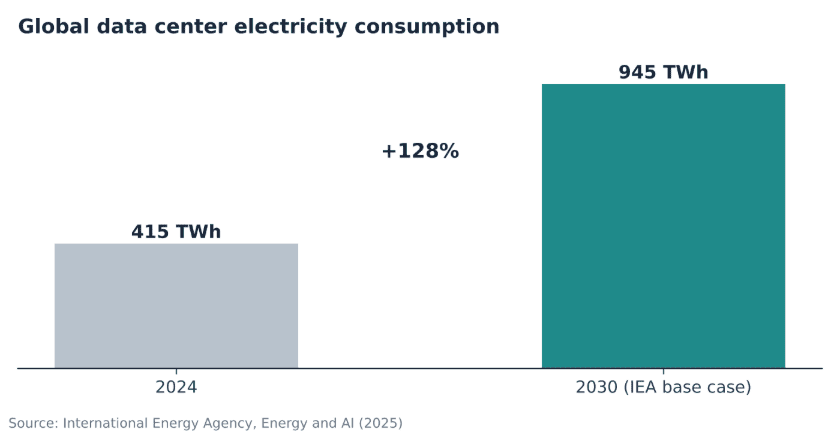
That formula is now running into physical limits. The International Energy Agency (IEA) estimates that data centers consumed about 415 terawatt-hours (TWh) of electricity in 2024. In its base case, that figure more than doubles to around 945 TWh by 2030, slightly more than Japan’s entire electricity consumption today, with AI the single largest driver of the increase.
Regulators are responding. In the United States, New York has imposed a one-year construction moratorium on data centers of 50 megawatts or more, Texas has paused approvals of new data center projects through its grid interconnection process, and Pennsylvania now requires local community approval. In Europe, Amsterdam has barred new data centers until at least 2030, Denmark has given data centers the lowest priority for grid connections, and new connections around Dublin must bring their own on-site power generation. In Malaysia, Prime Minister Datuk Seri Anwar Ibrahim told Parliament in February 2026 that applications for data centers unrelated to high technology and AI had been stopped, citing rising energy and water consumption and the risk of higher tariffs for ordinary consumers.
The AI industry is therefore approaching an inflection point. The question is no longer only how to build more AI infrastructure, but how to get dramatically more out of the infrastructure that already exists.
The end of the “more power, more servers” era
For years, AI progress was measured by scale. Bigger models needed larger datasets, larger datasets needed more storage, and more storage demanded more networking capacity, more servers and more data centers. The approach worked while capital was abundant and expansion faced few constraints.
Today, power availability is becoming a strategic bottleneck. Every new data center needs permits, a grid connection, cooling systems and community support, and each is getting harder to secure. As these constraints tighten, the economics of AI change. The winners of the next phase may not be the companies that consume the most computing power, but those that deliver the most intelligence per watt, per server and per byte of data.
Visual data is the pressure point
One of the least discussed challenges in modern AI is the growth of visual data. Autonomous vehicles, robots, drones, surveillance networks, industrial inspection systems and smart city sensors produce continuous streams of video and images that must be transmitted, stored and analyzed. This is the domain of Physical AI, systems that operate in the real world through cameras and sensors, and its data footprint grows with every machine deployed. A single autonomous platform can generate terabytes of data a day. Multiplied across fleets of vehicles, factories and city networks, sending all of it to centralized cloud infrastructure becomes expensive, energy-intensive and, in many cases, impractical.
Visual data places separate demands on networks, storage and computing systems, and each cost behaves differently. Smaller files reduce the amount of data transmitted and stored, which lowers bandwidth and storage costs, speeds up transmission and makes it more practical to process data at the edge, close to where it is captured. Whether smaller files also reduce AI inference work depends on how the data is decoded and processed. Even so, cutting data volume without losing usable information has a multiplier effect across the AI pipeline, and that effect grows as AI moves from pilot projects into industrial deployment.
Storage is also getting more expensive. Neurovia AI has cited a roughly fourfold increase in global unit data storage prices in 2026, and industry estimates quoted by the company put the direct annual benefit of each terabyte saved at US$1,000 to US$1,500 for an AI customer.
NeuroStream™: making data smarter before making infrastructure bigger
This is the problem NeuroStream™ is designed to solve. The platform is the flagship technology of Neurovia AI, an Abu Dhabi-based AI software and visual data company wholly owned by Dubai-headquartered Robo.ai Inc. (Nasdaq: AIIO). Rather than expanding infrastructure footprints, NeuroStream™ reduces the volume of visual data that must be transmitted, processed and stored, so organizations can make more efficient use of the infrastructure they already have.
The technology is built on what the company calls a Bitmap Vectorization Algorithm, which converts conventional bitmap image data into vectorized mathematical expressions. Processed files keep their original formats and can be opened without separate decompression software. The architecture is designed to run on low-compute edge hardware such as sensors, drones and mobile nodes, including in offline environments.
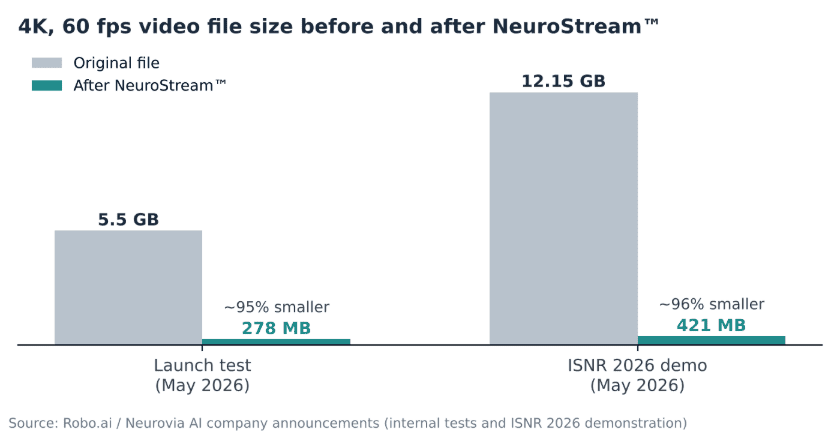
Neurovia AI has published two results so far. At the platform’s launch in May 2026, the company said internal tests reduced a 5.5GB 4K, 60-frames-per-second video to 278MB, a reduction of about 95%, while retaining resolution and frame rate. Later that month, at the International Exhibition for National Security and Resilience (ISNR) in Abu Dhabi, it demonstrated a 12.15GB 4K, 60fps raw video file compressed to 421MB, a reduction of more than 96%, with visually lossless quality. Both results are company-reported tests on single files, and real-world gains will depend on deployment conditions.
Following ISNR, Neurovia AI moved into a proof-of-concept (POC) phase with regional partners to test the architecture’s stability and efficiency in high-concurrency, enterprise-level environments. In November 2026, it served as Official Government AI Partner at the 3rd Government AI Summit in Abu Dhabi, where it presented NeuroStream™ as a way to cut the storage, bandwidth, compute and energy needed for visual data in government AI systems.
“Scaling artificial intelligence is not simply about deploying more powerful models,” said Neurovia AI Acting Chief Executive Officer Ahmed Alhashmi. Chief Technology Officer Mansoor Ali Khan added: “AI-ready infrastructure begins with intelligent data management.”
For Robo.ai, the acquisition marks a shift in direction. Chief Executive Officer Benjamin Zhai has described Neurovia AI as “a strategic cornerstone for Robo.ai’s long-term development” and said the company is “upgrading from a smart hardware enterprise to an AI infrastructure platform enterprise.” Robo.ai plans to use NeuroStream™ as a core data layer across autonomous driving, robotaxis, smart cities, manufacturing and robotics, with revenue expected from data infrastructure licensing, enterprise software-as-a-service and smart city solutions.
A shift in investor thinking
The first wave of AI investment centered on a straightforward set of questions: who sells the chips, who builds the servers and who constructs the data centers. The next wave may turn on a different question: who helps AI achieve the same outcomes with fewer resources.
Major infrastructure cycles have tended to follow this path. Railroads, telecommunications networks, the internet and cloud computing all reached a point where optimization became more valuable than expansion. AI appears to be entering a similar phase, as energy availability, infrastructure approvals and environmental considerations weigh more heavily on deployment decisions. Bandwidth efficiency, storage reduction, model compression and edge deployment could become as important to the AI stack as raw computation.
NeuroStream™ sits at the intersection of several long-term trends: AI deployment, edge computing, visual intelligence and infrastructure efficiency. The POC phase will be the next test of its commercial case. As the AI industry moves from a race for more computing power to a race for greater efficiency, technologies that do more with less may become some of the most valuable infrastructure enablers of the next decade.


This feels less like an AI story and more like an infrastructure efficiency story. That distinction might become more important over time. $AIIO