


Robo.ai’s transformation has improved its balance sheet and given the company a coherent position across data processing, computing, and sovereign infrastructure. However, its investment case now depends less on the accounting benefits of restructuring than on converting those complementary capabilities into sustainable margins and cash flow.
In a business update of September 2026 figures, the Company reported unaudited total September revenue over US$100 million, mostly from QC Capital Limited (“QC Capital”). To round out the calendar, a full year 2026 estimate of roughly US$600 million, was based on YTD analysis. Transition milestones included QC Capitals newly developed AI-generated video and content production, Neurovia AI’s commercial application, and the three-phase industrial park by ALIF Holding. A medium-term capex presented by the CEO of Robo.ai, for the upcoming 18-24 months to maintain the momentum of operations to build value across the long-term.
Robo.ai (AIIO) has undergone one of the more striking corporate transformations of 2026, shifting from a struggling EV manufacturer into a UAE-based AI infrastructure and deep-tech platform. The disposal of its EV business removed US$89.3 million in legacy liabilities associated with discontinued operations, swung net income into positive territory, and allowed the company to reposition around higher-value opportunities in artificial intelligence. This reset was accompanied by two strategic acquisitions, Neurovia AI and Quantum Core Capital, and the creation of Alif Holding. Together, these businesses provide the data-processing, computing, and infrastructure capabilities that define Robo.ai’s new identity.
Neurovia AI brings exclusive rights to advanced data-compression and processing technology, a critical enabler of real-time AI inference across public safety, transportation, energy, and municipal services. By reducing storage and transmission costs, Neurovia’s platform could allow cities and enterprises to scale AI applications without prohibitive infrastructure expenses. Quantum Core Capital, structured as a venture-building platform, contributed US$54.4 million of Robo.ai’s US$55.1 million total revenue during the first half of 2026. That concentration demonstrates QC Capital’s immediate importance to the group while also showing how dependent current revenue is on a single business unit. QC Capital also provides the compute backbone, GPU clusters, networking, and storage, for large-scale AI model training and deployment, while incubating deep-tech ventures that could feed into Robo.ai’s broader ecosystem.
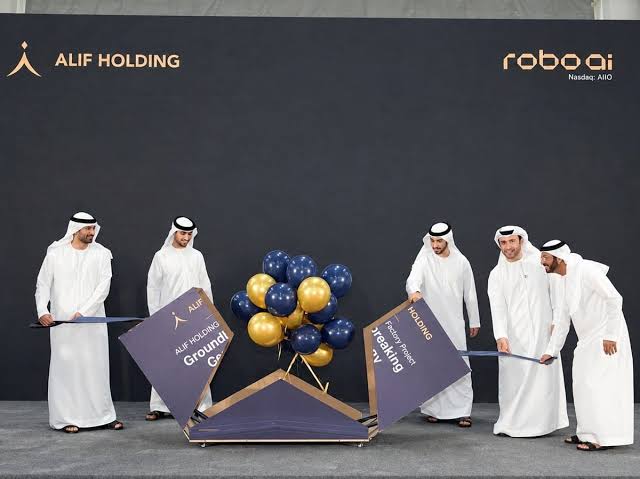
Alif Holding represents the industrial and sovereign-grade infrastructure arm of Robo.ai. Based in the UAE and led by high-profile figures such as Dr. Ahmed Naser Al-Raisi (former INTERPOL President) and Dr. Jasem Al-Mansory (ex-UAE Ministry of Interior), Alif Holding is positioned to secure government and public sector contracts in mission-critical domains. Its focus on AI-ready data centres, advanced materials, and secure infrastructure provides the physical foundation for Robo.ai’s ambitions, ensuring compliance and scalability for government ministries, defence, utilities, and large enterprises.
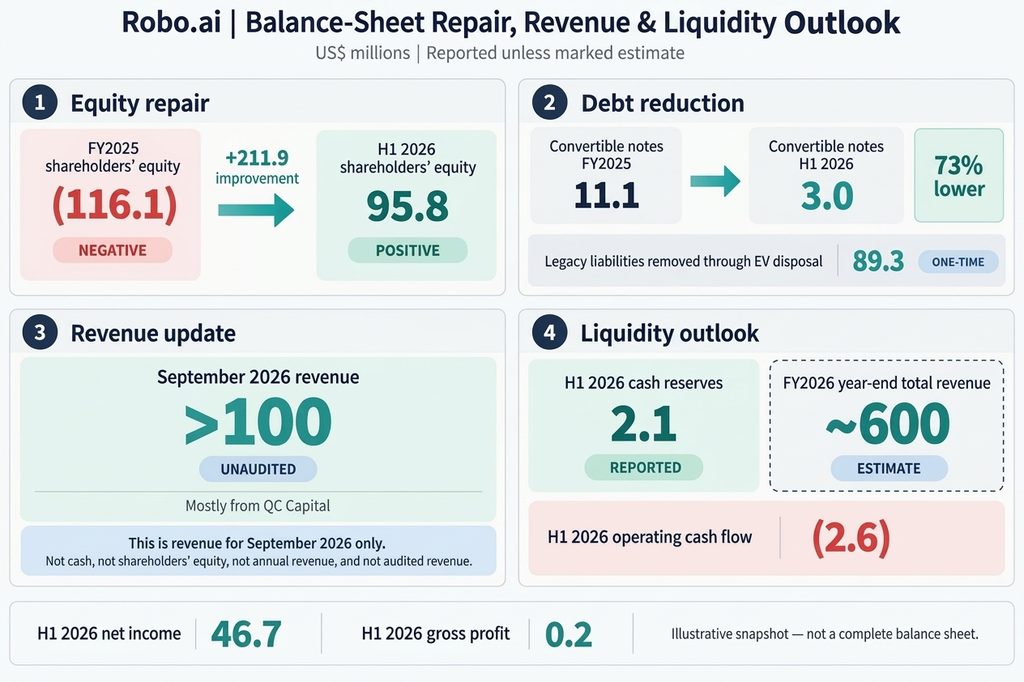
Financially, Robo.ai’s results show a repaired balance sheet but a fiscally moderated operating business. Shareholders’ equity swung from US -$116.1 million at year-end 2025 to US+$95.8 million in H1 2026. Net income reached US$46.7 million, driven largely by the EV disposal, while gross profit remained only US$0.2 million. Cash reserves stood at US$2.1 million and operating cash flow was negative at US-$2.6 million, raising going-concern doubts. Convertible notes declined from US$11.1 million to US$3.0 million, but the combination of low cash, negative operating cash flow, and thin gross profit means liquidity remains a pressing headwind. The September updates of unaudited US$100 million have turned this headwind into a gentle breeze along with the estimated year-end US$600 million total revenue.
Robo.ai is building a vertically integrated AI infrastructure ecosystem in which Neurovia supplies the data layer, QC Capital supplies the compute layer, and Alif Holding supplies sovereign-grade physical infrastructure. The combined stack could support smart surveillance, traffic-flow optimization, predictive public-transit scheduling, fleet management, and energy-grid monitoring. In a forward-looking scenario such as Dubai Smart Mobility 2030, Neurovia could compress traffic-camera feeds, QC Capital could run predictive traffic models, and Alif Holding could provide secure data centres, linking each business unit to measurable improvements in congestion, emissions, and public-safety response times.
Robo.ai has several clear tailwinds: a repaired balance sheet, strong revenue from QC Capital, government-sector credibility through Alif Holding, and an AI infrastructure strategy aligned with smart-city and public-safety initiatives. The counterweight is equally significant: thin operating margins, revenue concentration, and execution risk across acquisition integration and Neurovia’s commercialization. Robo.ai is therefore best understood as a high-risk, high-reward restructuring story, an early-stage sovereign AI infrastructure platform that could become a cornerstone of smart-city and mission-critical applications as it closes its financing gap, broadens its revenue base, and demonstrates repeatable execution.
Robo.ai’s transformation has created a credible foundation for long-term value, but the next phase will be defined by execution rather than ambition. Its integrated data, compute, and sovereign-infrastructure platform offers meaningful exposure to the growth of AI-enabled urban systems. Robo.ai’s turnaround could evolve from a compelling restructuring story into a durable AI infrastructure business.


What I like is that $AIIO management is talking about both growth and financial stability. Revenue is one side of the equation. The reported cash flow is the other.
While the world is solely focused on AI servers, chipsets, and personal chat, Robo.ai is developing the backbone of future deployments for smart urbanization. Examining the companies subsidiaries, it is clear that Management understands the deficit in application of AI into our day-to-day lives at a macro level.